


Igrika Crafts is a family-run art studio based in Tbilisi which specializes in block-printed textiles with traditional Georgian folk motifs. They graciously offered to organize a block-printing workshop for my fellow SRAS Tbilisi study abroad participants to teach us more about their art as well as the Georgian history, culture, and folk art which inspires it.
About Igrika Crafts
Igrika Crafts was first founded in 2020 as a small family crafts business producing handmade textiles, woodcarvings, and stamps embellished with imagery and symbols taken from Georgian history and folk culture. In the words of Baia Lomsadze, one of the founders of the studio, “Igrika was born from a deep fascination with the mystical and symbolic world of ancient Georgian culture. As the founders, we, Grigol Dalakishvili and Baia Lomsadze, wanted to revive these forgotten symbols and stories, bringing them into people’s everyday lives in a meaningful way.” They travel Georgia and scan ancient texts and artworks to gather inspiration for their art, which is instantly recognizable by their stylized imagery and patterns printed in bold primary colors.
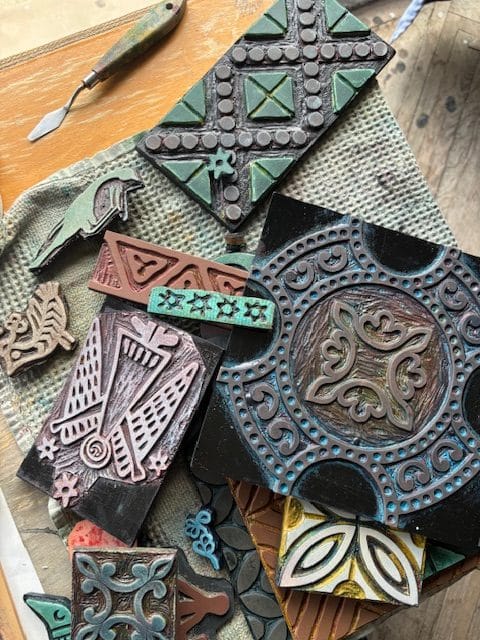
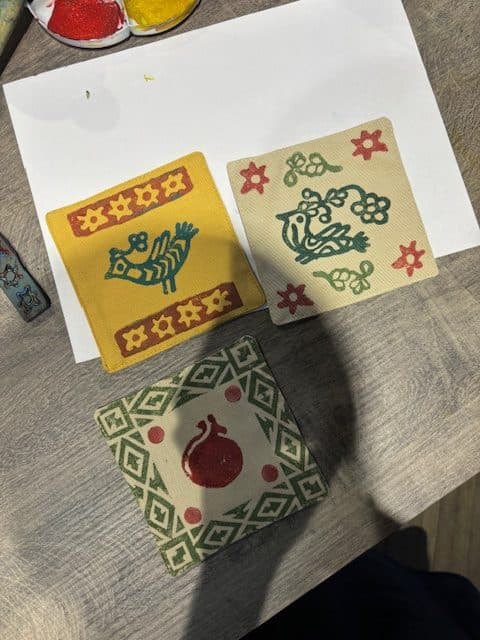
Igrika Crafts has stayed true to its original mediums since its founding, with their art consisting of block-printing on cotton and linen textiles, carving on wood, and painting on sustainable paper. Though they strive to source locally when possible, limited material availability in Georgia means that often they import quality, sustainable materials such as linens from Lithuania. Since its founding, Baia has expanded the studio to include more products, such as educational children’s games under the brand RTO, “which introduces folk tale characters to younger generations” and focuses on the practice of “storytelling through art.” Today, the studio sells its art online and at cultural festivals as well as participates in collaborations with interior designers. They also offer workshops for those seeking to learn about Georgian art and folk tales, which is how my SRAS cohort got the opportunity to visit them in their studio.
The Workshop
Igrika Crafts is located in a large community art building in Tbilisi that is full of many different studios, from art to music and dance. When we arrived at their studio, the family greeted us warmly and were eager to teach us about their craft. The studio walls are hung with examples of their colorful textile art and the hand-carved stamps which they use for block printing, many of which are available for purchase on their online store. The family invited us to spend some time looking through the art that they had available before beginning the class.
As part of the workshop, we learned from experts in the history of folk art of Georgia, and got the chance to use their block printing materials to create a large table runner adorned with Georgian motifs. In the first part of the class, Baia Lomsadze taught us about her craft and the many places from which Igrika draws inspiration, such as carvings from Georgian traditional houses and designs from old folk stories. She showed us many examples of ways they have reinterpreted these symbols, such as the “Moon Guard”, a protective figure from the 2nd millennium BC which appears throughout Georgian folk art. In her words, “We don’t just use these ornaments as decoration—we embed them into everyday objects so that people can live with cultural symbols in a meaningful way.”
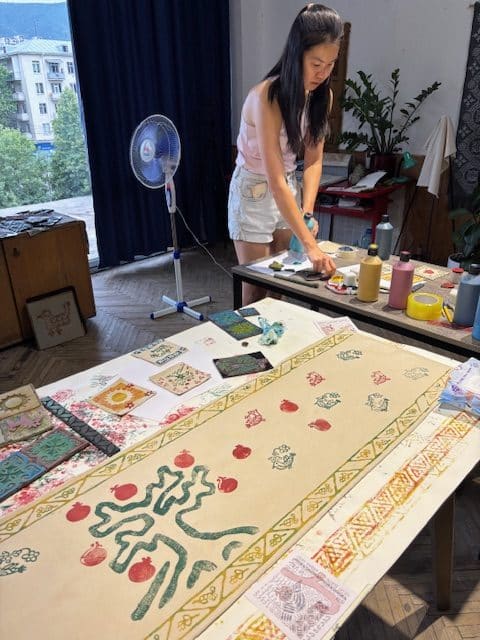
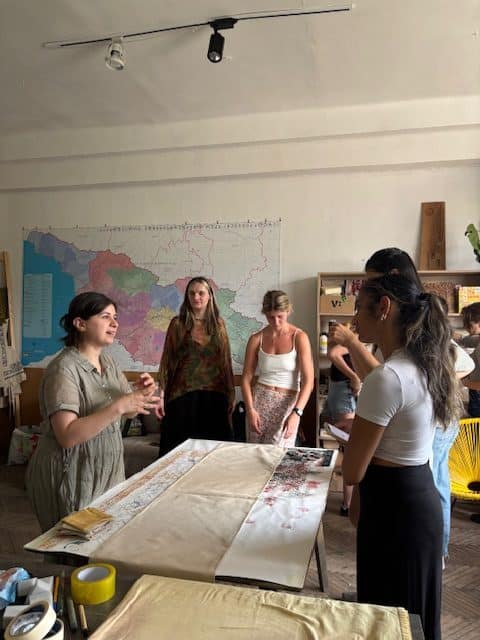
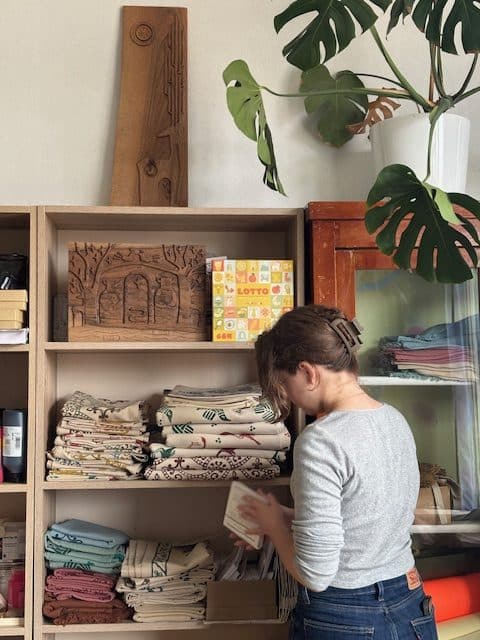
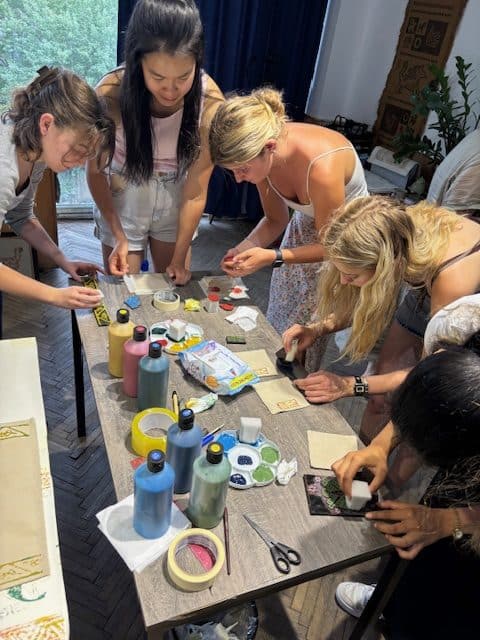
After our short lesson, she let us choose from their collection of hand-carved stamps and plan out how we could make our own block-printed tablecloth inspired by their many examples. Our class spent the next hour carefully adorning our tablecloth with colorful patterns, as Baia guided us and continued to teach us about the origin and story of each symbol we had chosen. After we finished, we had the chance to purchase personal linen coasters to decorate and take home to our families.
The Mission of Igrika
After our workshop, I spoke with Baia to hear more about the mission of Igrika Crafts and what the family hopes to achieve through their art in the future. She spoke of their hope that in the future they will be able to expand Igrika internationally to share Georgian cultural heritage with the world. They also hope to offer more workshops and lectures for the purpose of educating and sharing their craft.
Baia spoke of her plans to translate Georgian folk tales and stories into English, so that they might become more accessible to the world. She explained that because “our textiles and wooden crafts carry symbols from Georgian stories, translating folk tales would allow us to share those same stories with a wider audience—making our art and words part of one larger storytelling mission.”
When I asked Baia what she wanted the world to know about Georgian folk art, she replied that “Georgian folk art is not only national—it’s a global treasure that embodies universal values and timeless beauty. Preserving these traditions is a way of keeping Georgia’s cultural identity alive while also sharing it with the world… We believe the wisdom each story carries belongs to the whole world, not just us Georgians, and it helps us as humans to find our true identities.”
You can learn more about Igrika Crafts through their website, igrikashop.com, as well as purchase their unique artwork for yourself. They are also active on their Instagram account, @igrika_crafts.
You’ll Also Love

The Tbilisi History Museum
The Tbilisi History Museum is a quick peak into the city’s 19th century past that helps solidify its importance as a commercial hub at the cultural crossroads of the Persian, Ottoman, and Russian empires. Housed in a historic building with other worthwhile museums and telling its story through models, life-size dioramas, historic photographs, and other […]

Museum of Georgian Medicine: Two Stories Told
Two visitors had two very different experiences at the same museum – visiting just days apart. The Museum of the History of Georgian Medicine examines Georgia’s long history through the context of medicinal practices. Along the way, we learn quite a lot of Georgia’s identity and even genetic makeup. This particular museum is a reminder […]

Soviet Mosaics in Georgia: Controversy, History, and Fascination
I can’t put my finger on what sparked my interest in Soviet-era mosaics, but at this point, I’m obsessed. As someone who grew up in the US, it’s a rather foreign thing to see the sides of entire buildings decked out in brightly colored scenes made of tiles. It also contradicts what many people believe […]

Fortress of Gonio: Georgia’s Roman Heritage
The Fortress of Gonio, located in Adjara, Georgia, is an ancient Roman fortification dating back to the 1st century AD. A strategic point along the Black Sea coast, over the centuries, it was expanded and fortified by the Byzantines and Ottomans. Today, the well-preserved remains of Gonio Fortress stand as an important cultural and archaeological […]

Museums as Self-Care
In 2018, doctors in Montreal began prescribing visits to the Montreal Museum of Fine Arts (MMFA) for patients experiencing depression, anxiety, and other health issues. This innovative approach to mental health treatment was launched under the initiative of the MMFA in collaboration with Médecins francophones du Canada (MFdC). The program allows physicians to provide patients […]


